Nowadays, the process of music editing still uses the
digital equivalent of the old tape-splicing techniques. There is
quite a gap between the level at which musicians and the recording
team communicate and the kind of operations that are supported by
modern digital audio equipment. In particularly, operations
involving the musical structure and expression are not supported.
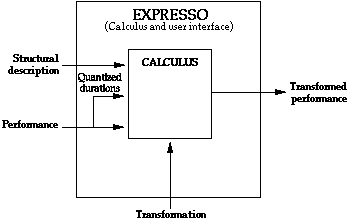
However, given richer and more structured (knowledge)
representations of music than the ones in use today (i.e., audio
signals and MIDI), musical performance expression can be brought
under the control of the recording team. This is the key idea of
the Expresso system: to facilitate editing operations that are
meaningful at a musical level, with perceptually sound results. It
is based on a calculus of expression that was designed to formally
describe how different types of expression (onset timing, offset
timing, dynamics, asynchrony) are linked to different types of
musical structure (phrase, metrical, chord, voice, and surface
structure), and how they can be manipulated while maintaining
consistency.
[play]
A fragment of a performance by Philip Mead of the Second Piano
Etude by Gyorgy Ligeti. It was recorded on a Yamaha Midi-grand
piano, and played-back on a synthesiser with a piano-like
sound.
[play]
The performance transformed using Expresso by exaggerating
expressive dynamics at the beat level (expressive dynamics are
here defined as an averaging type of expression: taking the mean
dynamics of every beat -two notes in parallel- and scaling their
contrast with respect to this norm).
[play]
The performance transformed by exaggerating all expressive timing
(tempo) that can be assigned to the phrasing in the right hand
voice, while keeping the articulation consistant.
Common Lisp code / microworld